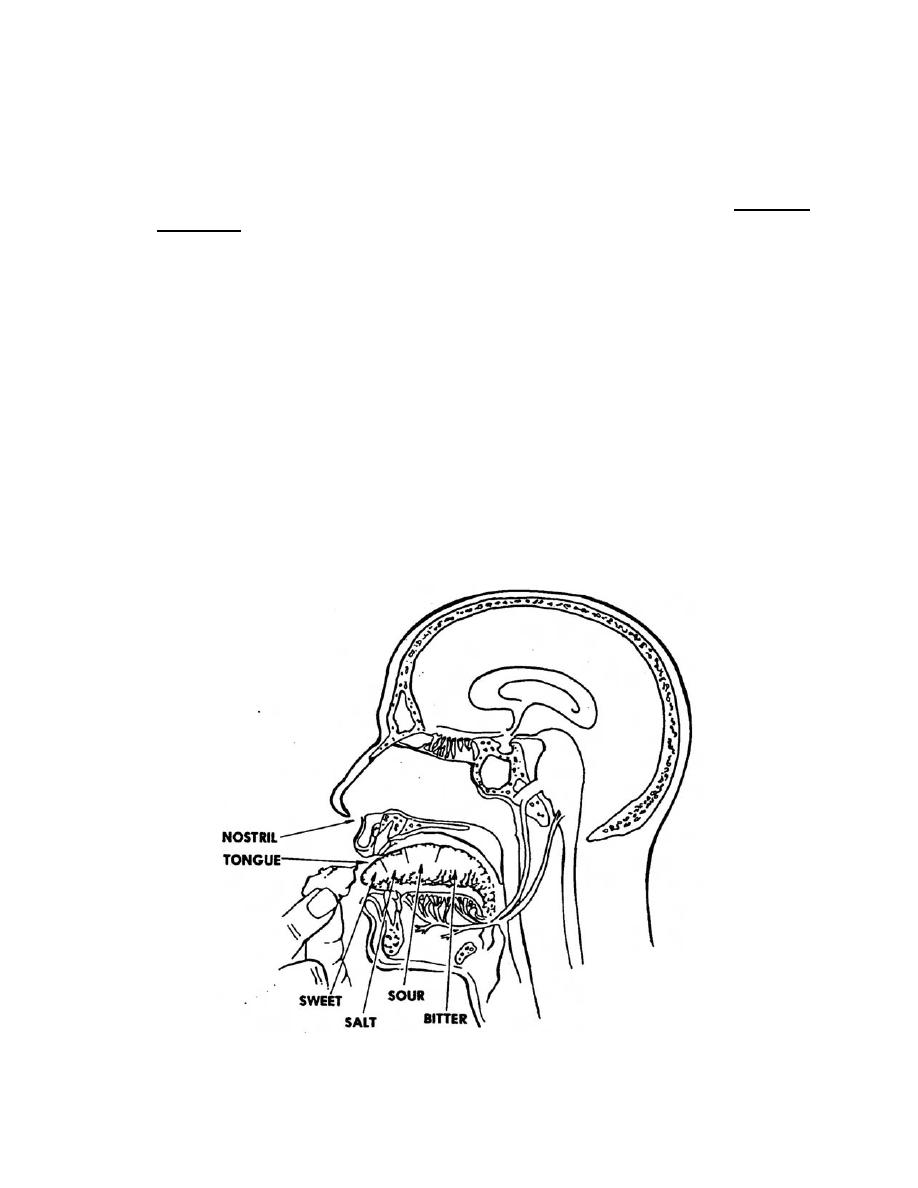
Eli5 Why does plugging your nose make it to where you dont taste Biology Diagrams Taste is a chemical sense. The sensory experience is produced by stimulation of specific receptors in the oral cavity. The gross anatomy (peripheral and central nervous system) of taste, microscopic and ultrastructural morphology of taste buds, physiology of taste (modalities, distribution of taste sensations, electrophysiology of the receptors, mechanism and intensity of stimulation, and

The taste system, acting in concert with the olfactory and trigeminal systems, indicates whether food should be ingested. Once in the mouth, the chemical constituents of food interact with receptors on taste cells located in epithelial specializations called taste buds in the tongue. The taste cells transduce these stimuli and provide additional information about the identity, concentration The Anatomy of the Lymphatic and Immune System. 111. Barrier Defenses and the Innate Immune Response. 112. The Adaptive Immune Response: B-lymphocytes and Antibodies. XIX. The Digestive System. 82 Taste and Smell Taste and smell are both abilities to sense chemicals, so both taste and olfactory (odor) receptors are chemoreceptors.

Taste System Anatomy: Overview, Gross Anatomy, Microscopic ... Biology Diagrams
Taste and smell work together and are hard to separate from each other, which is why holding your nose can sometimes reduce the nasty taste of a dose of medicine. Within each papilla are found a hundred or so taste buds; each of these taste buds comprises 30-100 taste receptor cells and basal cells. Basal cells are glia-like cells which provide Taste itself is focused on distinguishing chemicals that have a sweet, salty, sour, bitter, or umami taste (umami is Japanese for "savory"). However, interactions between the senses of taste and smell enhance our perceptions of the foods we eat. Tastants, chemicals in foods, are detected by taste buds, special structures embedded within

Central taste anatomy and physiology. et al. (1989). Characteristics of rat lateral hypothalamic neuron responses to smell and taste in emotional behavior. Brain Res. 491: 15-32. [Google Rolls ET (1989). Information processing in the taste system of primates. J. Exp. Biol 146: 141-164. [Google Scholar] Rolls ET (2016). The sense of taste relies on well-defined neuroanatomical structures, namely, the taste buds and afferent nerve fibers. Taste buds are clusters of 50-100 neuroepithelial cells located throughout the oral cavity, including the epiglottis and larynx. They are responsible for the initial transduction p … No headers. Taste and smell are both chemical senses; that is, the stimuli for these senses are chemicals.The more complex sense is olfaction. Olfactory receptors are complex proteins called G protein-coupled receptors (GPCRs). These structures are proteins that weave back and forth across the membranes of olfactory cells seven times, forming structures outside the cell that sense odorant